
Guide
Dropped or Non-Renewed After an Accident
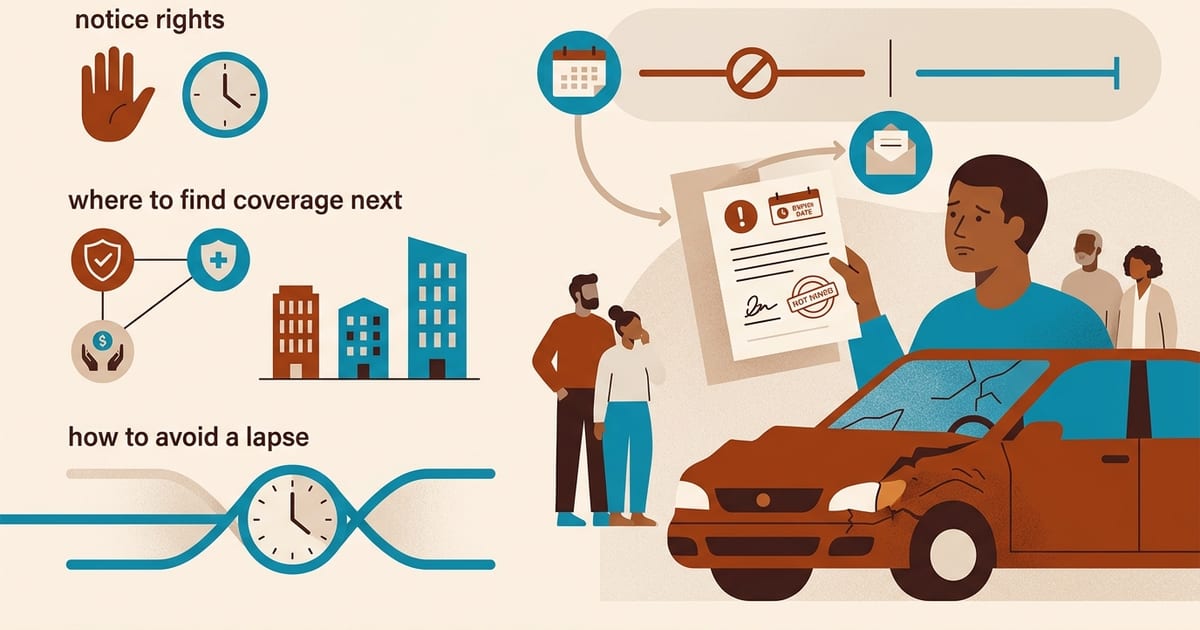
Why insurers non-renew after accidents, the difference from cancellation, your notice rights, where to find coverage next, and how to avoid a lapse.

By Nathan Price · Research Writer
Published · Updated
Answer in brief
An insurer may non-renew your policy after an at-fault accident—more likely after two or more claims in three years, an accident with injuries, or an accident combined with violations. Non-renewal is different from mid-term cancellation (which is restricted to non-payment, fraud or licence loss in most states) and requires advance written notice, typically 30–60 days. Use the notice period to shop; non-standard insurers and comparison tools will quote you. Never let the old policy end before the new one starts.
| Term | Meaning | Notice (typical) |
|---|---|---|
| Non-renewal | Insurer declines to offer a new term | 30–60 days before expiry |
| Mid-term cancellation | Policy ends before expiry; limited grounds | 10–30 days |
| Rescission | Policy voided for misrepresentation | Varies |
What to do with the notice
- 1
Read the reason
Insurers must state it in most states; it tells you what new insurers will see.
- 2
Get your records
Driving record and claims history report; dispute errors.
- 3
Quote widely
Comparison tool plus non-standard specialists; be accurate about the accident.
- 4
Bind before expiry
New policy starts the day the old one ends.
- 5
Plan the re-shop
After one clean year, standard insurers often return.
If you think it is unfair
Your state insurance department handles complaints about improper non-renewal and can confirm whether the notice period and grounds complied with state rules.
Entries in this guide
Specific questions answered in more depth.
Questions & answers
Can my insurer drop me after one accident?
At renewal, yes, though it is more common after multiple claims or an accident with injuries.
How much notice must they give?
Typically 30–60 days before the policy ends, depending on state.
Will I be able to find new insurance?
Yes. Non-standard insurers write drivers with recent accidents; rates are higher for a few years.
Terms used in this guide
- Non-renewal
- The insurer declining to offer a new policy term; requires advance notice.
- Mid-term cancellation
- Ending a policy before expiry; limited in most states to non-payment, fraud or licence loss.
- Non-standard insurer
- An insurer that specialises in drivers with accidents, violations or lapses.
- Coverage gap
- A period without insurance; raises future rates and may suspend registration.
Sources and references
Legal figures on this page (minimum limits, filing periods, statutory benefits) are checked against the primary law or the state insurance regulator listed below. Links and figures last verified Nov 2026.
- Facts + Statistics: Highway safety — Insurance Information InstituteStatistical dataCrash, injury and fatality trends used to explain why liability and injury coverages cost what they do.
- Consumer insurance information — National Association of Insurance CommissionersConsumer guidancePlain-language guides from the body of state insurance regulators; links to every state's insurance department and complaint process.
- What is covered by a basic auto insurance policy? — Insurance Information InstituteConsumer guidanceDefines bodily injury and property damage liability, MedPay, PIP, uninsured/underinsured motorist, collision, comprehensive and glass coverage.
- How to file an auto insurance claim — Insurance Information InstituteConsumer guidanceSteps after a crash: document the scene, notify the insurer promptly, understand the adjuster's role.
- What determines the price of an auto insurance policy? — Insurance Information InstituteConsumer guidanceRating factors: driving record, mileage, location, age, gender, vehicle, credit-based insurance score, coverage choices. Notes ZIP-code rating is prohibited in California and Michigan and gender rating is prohibited in seven states.
- Understanding your insurance deductibles — Insurance Information InstituteConsumer guidanceHow deductibles apply to collision and comprehensive and how raising them lowers premium.
Practical guidance on this page is original editorial work. Cited sources support factual statements and do not endorse this site. Dollar ranges described as typical or illustrative are editorial estimates, not figures from these sources.
Guide
How Long an Accident Affects Your Car Insurance
The three- and five-year lookback periods, how surcharges step down, when the accident drops off your record, and how state rules differ.
Guide
How to Lower Car Insurance After an Accident
Steps that reduce a post-accident premium: shop insurers with lighter surcharges, raise deductibles, review coverage, telematics, discounts, and timing.
Guide
How to Compare Car Insurance Quotes After an Accident
A comparison method for drivers with a recent accident: disclose accurately, fix coverage, quote widely including non-standard insurers, and normalise costs.