
Entry in Dropped or Non-Renewed After an Accident
What to Do If Car Insurance Drops You After an Accident
Learn what steps to take if your insurer issues a non-renewal notice after an accident, how to avoid coverage lapses, and where to find replacement coverage.

By Nathan Price · Research Writer
Published
Answer in brief
Receiving notice that your car insurance provider will not renew your policy after a crash can feel overwhelming, but immediate steps protect your driving privileges. Understanding the crucial difference between mid-term cancellation and non-renewal allows you to secure replacement coverage through the standard market, non-standard insurers, or state assigned-risk pools before experiencing an illegal coverage lapse.
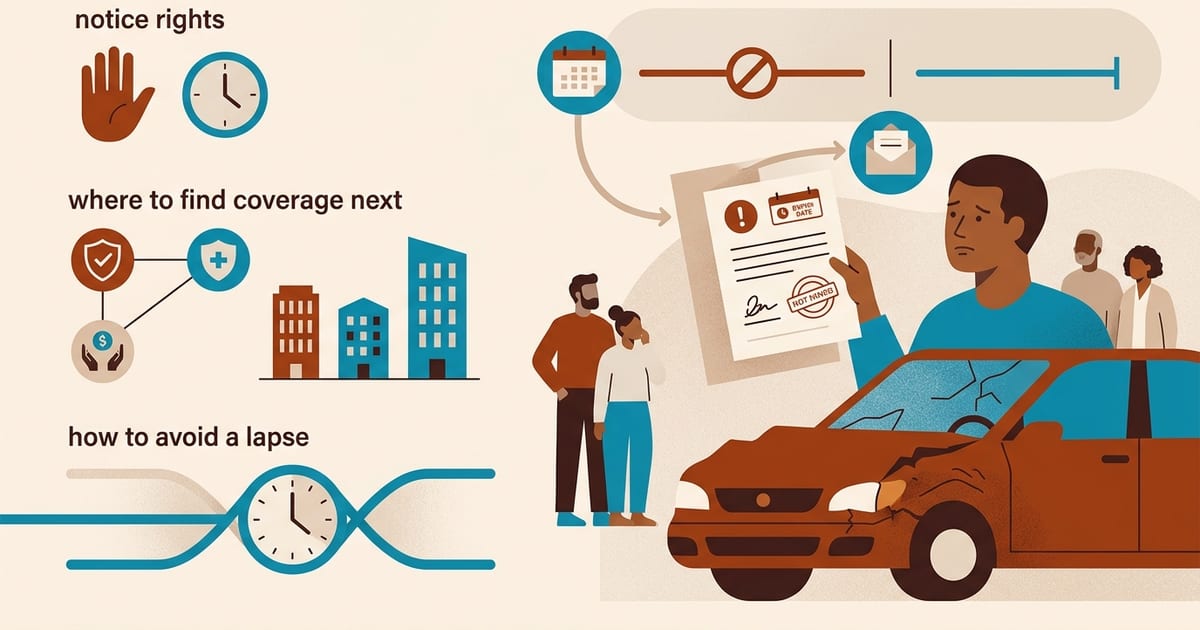
Mid-Term Cancellation vs. Non-Renewal: Understanding Your Notice
When drivers discover that their insurer no longer wishes to cover them, they often describe the situation as having been dropped. In insurance regulation, however, there is a fundamental distinction between a mid-term glossary/cancellation/ and a policy glossary/nonrenewal/. A cancellation takes effect before the policy term expires, while a non-renewal means the carrier will not extend a new policy once your current term ends. State laws tightly restrict mid-term cancellations, typically limiting them to non-payment of glossary/premium/, fraud, material misrepresentation, or a suspended driver's license. In contrast, insurers generally possess broader discretion to issue a non-renewal at the end of your policy period if your risk profile changes substantially after an glossary/at-fault-accident/.
Why Insurers Choose Non-Renewal After a Collision
Insurers establish strict underwriting guidelines to evaluate their overall loss exposure. Following a serious collision or multiple smaller incidents, an underwriter recalculates your likelihood of future losses. If a glossary/chargeable-claim/ pushes your overall driving profile past the carrier's approved risk threshold, the company may conclude that even an added glossary/surcharge/ cannot offset the statistical probability of another claim. Your glossary/claims-history-report/ documents the date, fault determination, and payout details of every reported incident, which carriers review each renewal cycle.
State statutes require carriers to provide formal written explanation and sufficient advance warning when issuing a non-renewal. This window gives policyholders time to arrange replacement protection. The National Association of Insurance Commissioners notes that nationwide consumer expenditure for auto coverage averaged $1,281 in 2023, but drivers entering the higher-risk category face elevated rate baselines across replacement carriers.
Five Steps to Take Immediately After Receiving a Non-Renewal
- 1
Examine the Official Non-Renewal Notice
Review the exact termination date and the cited underwriting justification. Confirm that the notification complied with your state's mandatory advance notice timeframe.
- 2
Inspect Your Claims History Record
Request your comprehensive loss underwriting exchange file to verify that the accident details, payout amounts, and fault designations match the facts of your crash.
- 3
Shop for at Least Three Replacement Quotes
The Insurance Information Institute recommends gathering at least three separate insurance quotes, as underwriting guidelines for drivers with recent claims vary significantly between carriers.
- 4
Investigate Non-Standard Auto Insurers
If mainstream carriers decline to write a policy, seek quotes from a glossary/non-standard-insurer/, which specializes in drivers with recent collisions or violations.
- 5
Contact the State Assigned-Risk Plan If Necessary
Drivers unable to secure coverage in the voluntary insurance market can access their state assigned-risk plan, ensuring mandatory minimum legal liability protection remains in force.
Evaluating Your Replacement Market Options
Being non-renewed does not permanently banish a driver to high-risk pools. Many standard carriers compete for drivers who have had a single chargeable claim, particularly if that driver maintained an otherwise clean driving record during the insurer's standard three- to five-year glossary/lookback-period/. The key is identifying which tier of the market best accommodates your circumstances.
| Market Segment | Intended Risk Profile | Coverage Options | Typical Premium Level |
|---|---|---|---|
| Standard Voluntary Market | Drivers with 0–1 minor incidents, good credit scores | Full coverage: liability, comprehensive, collision, MedPay, UM/UIM | Moderate baseline with standard claim surcharge |
| Non-Standard Market | Drivers with multiple accidents, recent non-renewals, or lapses | State minimum liability up to complete physical damage packages | Higher baseline premiums structured for elevated risk profiles |
| State Assigned-Risk Pool | Drivers declined by multiple voluntary carriers | Mandatory state financial responsibility minimums | Regulated high-risk statutory rates |
How to Lower Premiums When Starting a New Policy
Securing a new policy after an accident surcharge often results in higher initial quotes, but practical adjustments can soften the financial impact. According to guidance from the Insurance Information Institute, increasing your collision and comprehensive glossary/deductible/ from $200 to $500 can cut physical damage coverage costs by 15% to 30%, while opting for a $1,000 deductible can reduce those costs by 40% or more. For older vehicles where physical damage coverage exceeds 10 times the annual collision and comprehensive premium, dropping optional physical damage coverage altogether may be economically sensible.
Drivers should also inquire about defensive driving course credits, multi-policy bundling discounts, and low-mileage allowances. For further details on navigating post-claim requirements, explore our comprehensive guide on how to lower car insurance after an accident or review how to compare car insurance quotes after an accident.
Questions & answers
Can an insurance company drop me in the middle of my policy after an accident?
Generally, no. State insurance regulations strictly limit mid-term cancellations to specific situations such as non-payment of premium, material misrepresentation, fraud, or driver's license suspension. An accident alone typically cannot trigger mid-term cancellation; instead, the insurer must wait until your policy renewal date to issue a non-renewal notice.
How much advance notice must an insurer give before a non-renewal?
State statutes establish mandatory notification windows, which typically require insurers to send written notice 20 to 45 days before the policy's expiration date. This ensures you have adequate time to find replacement coverage.
What happens if no regular insurer will accept my application?
If voluntary market insurers decline coverage, you can obtain a policy through the non-standard insurance market or your state's assigned-risk auto insurance plan, which guarantees access to mandatory financial responsibility limits.
How long will a non-renewal affect my insurance options?
The non-renewal notice itself is an underwriting outcome rather than a separate penalty, but the underlying accident remains on your claims history for the insurer's standard lookback period, which is typically three to five years.
Terms: Non-renewal, Mid-term cancellation, Non-standard insurer, Coverage gap, Claims history report
Sources and references
Legal figures on this page (minimum limits, filing periods, statutory benefits) are checked against the primary law or the state insurance regulator listed below. Links and figures last verified Nov 2026.
- 2019–2023 Auto Insurance Database: average premium supplement — National Association of Insurance Commissioners (2025)Statistical dataCountrywide average expenditure $1,281 in 2023 (+13.98%); combined average premium $1,438; state tables for liability, collision and comprehensive.
- Facts + Statistics: Highway safety — Insurance Information InstituteStatistical dataCrash, injury and fatality trends used to explain why liability and injury coverages cost what they do.
- What if I can't find auto coverage? — Insurance Information InstituteConsumer guidanceHow the non-standard market and state assigned-risk plans insure drivers the voluntary market declines.
- What determines the price of an auto insurance policy? — Insurance Information InstituteConsumer guidanceRating factors: driving record, mileage, location, age, gender, vehicle, credit-based insurance score, coverage choices. Notes ZIP-code rating is prohibited in California and Michigan and gender rating is prohibited in seven states.
- Nine ways to lower your auto insurance costs — Insurance Information InstituteConsumer guidanceShop at least three quotes; raising a deductible from $200 to $500 can cut collision/comprehensive cost 15–30%, $1,000 can save 40%+; drop physical damage on cars worth under 10× the premium; bundling, low-mileage and good-student discounts.
- Is it legal to drive without insurance? — Insurance Information InstituteConsumer guidanceEvery state requires drivers to demonstrate financial responsibility; in most states insurance is the mandatory way to do so.
- Consumer insurance information — National Association of Insurance CommissionersConsumer guidancePlain-language guides from the body of state insurance regulators; links to every state's insurance department and complaint process.
- How to file an auto insurance claim — Insurance Information InstituteConsumer guidanceSteps after a crash: document the scene, notify the insurer promptly, understand the adjuster's role.
Practical guidance on this page is original editorial work. Cited sources support factual statements and do not endorse this site. Dollar ranges described as typical or illustrative are editorial estimates, not figures from these sources.